Everything you need to prove what's exploitable.
Step-by-step guides to run, buyer guides to evaluate the market, and explainers for the ideas in between. Usable with or without Hayrok.
One read from each collection
 GUIDE
The CISO's guide to governed security validation
How approved run plans, guardrails and signed evidence let you test like an attacker without the production risk.
Security leadershipRead → BUYER GUIDE
The security validation platform comparison guide
What scanners, BAS, pentesting and validation platforms each answer well, and a 0–3 scoring model for evaluating vendors.
Buyers and evaluatorsRead → EXPLAINER
Continuous threat exposure management, explained
What CTEM is, how its stages fit together and where validation sits in the cycle.
Exposure management leadsRead →Step-by-step guides
Methods and programs you can run this quarter, from proving one finding to standing up CTEM.
The CISO's guide to governed security validation
How approved run plans, guardrails and signed evidence let you test like an attacker without the production risk.
Security leadershipRead →
CTEM guide: run your first exposure management cycle in 90 days
The five CTEM stages with a definition of done for each, a maturity self-check, a 90-day rollout and the metrics to report.
Exposure management leadsRead →
Adversarial exposure validation (AEV): what it is and how it works
How AEV proves which exposures attackers can actually exploit by safely emulating real attacks against your live defenses.
Security leadershipRead →
How to validate whether a vulnerability is actually exploitable
Five checks in order: code present, reachable, conditions met, controls bypassed, impact confirmed.
Vulnerability managementRead →
How to prove a finding is exploitable before remediation
A five-part evidence package for every ticket and a proof-based way to rank the remediation queue instead of CVSS.
AppSec and remediationRead →
How to validate security controls continuously
A six-step program to catch control drift after every change and show auditors your defenses still work.
Security operations and GRCRead →Evaluate the market
A vendor-neutral scoring framework, 2026 market roundups and how validation compares with adjacent categories.
The security validation platform comparison guide
What scanners, BAS, pentesting and validation platforms each answer well, and a 0–3 scoring model for evaluating vendors.
Buyers and evaluatorsRead →
AI red teaming tools: how to choose one
Attack frameworks, evaluation suites, guardrails, managed red teams and application-level validation: what each tests and where each stops.
AI security teamsRead →
API security testing tools: how to choose one
DAST scanners, fuzzers, posture platforms, manual pentests and application-level validation, compared against the OWASP API Top 10.
AppSec and API teamsRead →
Best adversarial exposure validation platforms in 2026
What Gartner's AEV category covers and how to pick a platform for CTEM.
CTEM program ownersRead →
Best automated penetration testing platforms in 2026
Compared by coverage, safety in production, retesting and compliance evidence.
Offensive security teamsRead →
Best breach and attack simulation platforms in 2026
How BAS differs from exploitation-based validation, and which approach fits your program.
Detection and SOC teamsRead →
Best continuous security validation platforms in 2026
How the leading platforms differ, and how to choose one for your CTEM program.
CTEM program ownersRead →
Hayrok vs vulnerability scanners
Scanners find possible weaknesses. Validation shows which ones create real risk.
Vulnerability managementRead →
Hayrok vs breach and attack simulation
Go beyond simulated activity and validate security outcomes with evidence.
Detection and SOC teamsRead →
Hayrok vs pentest automation
Go beyond automated testing to continuous, governed validation.
Offensive security teamsRead →
Hayrok vs exposure management
Prioritization estimates risk. Validation confirms it.
Exposure management leadsRead →
Hayrok vs attack path management
Do not just model possible paths. Validate the paths attackers can actually use.
Security architectureRead →
Hayrok vs detection validation
Prove what you detect, and what the undetected activity can reach.
Detection engineeringRead →Concepts, explained
Short reads on the concepts behind security validation, with references worth keeping open.
Continuous threat exposure management, explained
What CTEM is, how its stages fit together and where validation sits in the cycle.
Exposure management leadsRead →
Continuous security validation, explained
What continuous validation is and how it differs from point-in-time testing.
Security leadershipRead →
Exposure validation, explained
The four validation questions, six common exposures walked through, and how low-severity issues chain into critical paths.
Exposure management leadsRead →
Breach and attack simulation (BAS), explained
How BAS tests controls with safe, repeatable techniques mapped to MITRE ATT&CK, and the four outcomes every simulation produces.
Detection and SOC teamsRead →
Governed adversarial exposure validation
Adversarial exposure validation where every run is approved, scoped and recorded.
Security leadershipRead →
The attack path primer
The fundamentals of attack paths: how weaknesses chain from an entry point toward critical assets.
Anyone new to the topicRead →
AI-powered penetration testing vs traditional pentests
How AI-driven and human-led testing differ in coverage, cadence and evidence.
Offensive security teamsRead →
BAS vs penetration testing
What each proves, where each stops, and how to combine them into one continuous program.
Buyers and evaluatorsRead →
The autonomous testing governance framework
Approvals, scope enforcement, rollback and the evidence auditors need for AI security testing.
Security leadership and GRCRead →
Safe production testing
Why staging results drift, the four safety levels, guardrails like scope locks and circuit breakers, and a pre-flight checklist.
Security operationsRead →
Change control for offensive security testing
Run tests through your CAB: standard changes, test windows, rollback and evidence.
Change and IT operationsRead →
Audit-ready security evidence
What makes testing evidence hold up with auditors, and how to produce it from every run.
GRC and auditRead →
Replayable proof for AI security testing
What a replay package holds and how to verify any finding an agent reports.
Security leadershipRead →
Kubernetes isolation proof
Test namespace, network and RBAC boundaries and show customers tenant isolation holds.
Platform engineeringRead →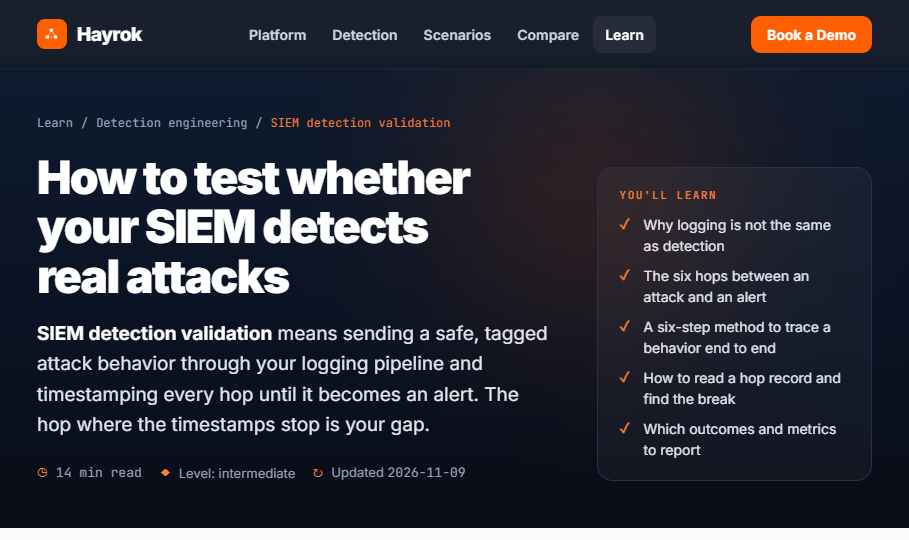
How to test whether your SIEM detects real attacks
The hops between an attack and an alert, a tracing method and a worked Sentinel example.
Detection engineeringRead →
Security validation glossary
Clear definitions for modern security validation terms.
EveryoneRead →
Validation maturity model
Measure your progress from scanning to continuous revalidation.
Program ownersRead →See one of these methods run on a real attack path.
Bring one objective. The session is shaped around it.